
Development vs. Acquisitions (Real Estate Careers)
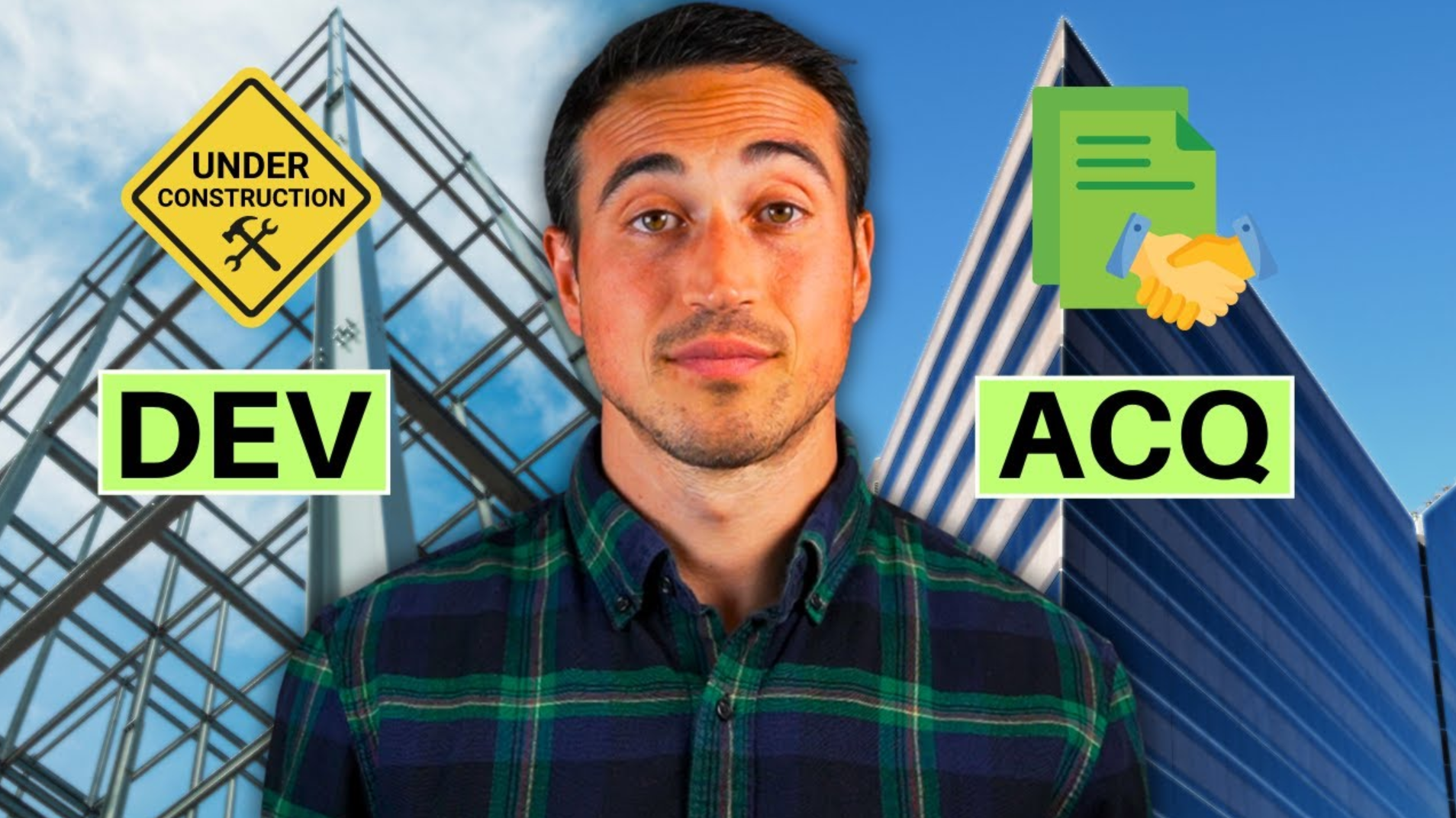
In commercial real estate, acquisitions and development roles often get lumped in together when talking about different career paths, but each of these will give you very different experiences.
These include different day-to-day responsibilities, different people that you’ll be working with, and even different considerations for real estate entrepreneurs who are planning to go out on their own.
And in this post, we’ll talk through the main differences between a career in real estate acquisitions and a career in real estate development, and which one might be best for you.
Watch the Full Video Here:
Real Estate Development
Let’s start out by talking about careers in development first, where you’re working on the acquisition of raw land and the construction of new buildings.
Day-to-Day Responsibilities in Real Estate Development
On a day-to-day basis, when you’re working in development, a lot of your focus is going to be on project management, construction oversight, and constant coordination with capital providers (including both equity investors and lenders) that will very likely need to fund your projects over an extended period of time.
Development roles also typically require a lot of work directly with city planning departments and local government officials to get projects approved. You’ll also be spending a lot of time with general contractors, architects, and structural engineers to design projects that both make sense financially and appeal to potential tenants in the market.
Development roles also often involve a lot of what’s referred to in the industry as “value engineering,” where you’re constantly going back and forth with construction and design professionals to create the product you’re looking for at the lowest possible cost.
The Long Timeline Challenge
Taking a development project from start to finish can also take a really long time, and in some markets, it can take years just to get a project approved. On top of that, it will usually also take another few years to actually build the project, and then another 6-9 months or more to lease up the property and stabilize the asset.
This can be really tough for people who like to see quick results and the tangible outcomes of their work, and this is especially difficult for real estate entrepreneurs who are just starting out and reliant on fee income to keep the lights on.
Development Risk
Development is also a very high-risk part of the business, since construction costs, market rents, interest rates, and even investor demand can all fluctuate significantly between the time a parcel of land is acquired and the time a property is built and operational.
The Upsides of Development
On the other side of the spectrum, one of the best parts about being in development is that you’re actually building something new from scratch, and creating something that’s very likely needed in the area. This might be a warehouse that can ship products to customers more quickly, clean and safe affordable housing for individuals and families, or even just a more convenient place for people to shop that’s much closer to their home or office.
Developer fees can also start to become substantial as you get into bigger projects, since these are often calculated as a percentage of total project costs. These fees are also usually not reliant on the performance of the investment itself, meaning that developers can still often make great money even if the market takes a turn for the worst during the construction period.
Real Estate Acquisitions
On the acquisitions side of the industry, where you’re working on investments in existing properties that are already operational, your day-to-day responsibilities can look substantially different for a few different reasons.
Working with Known Variables
A lot of your work in acquisitions is going to be focused on analyzing cash flows that already exist, with in-place rents and expenses that are known variables up front, and this means that a lot of the assumptions you’ll need to make from a financial modeling perspective have often already been proven out at the property over time.
Because these properties are already operational, they’ll also typically have in-place leases at the time you’re underwriting a deal, which can add an additional layer of certainty into the underwriting process.
Much Faster Timeline
Since existing, operational properties have already been built and approved by local governments, you typically won’t need to spend months or years going through the permitting process or getting into the weeds on complex zoning laws. Because of this, the acquisition of an existing property usually won’t take more than about 60-90 days between the time the property is identified and the time the transaction is closed.
Faster Path to Revenue for Entrepreneurs
For real estate entrepreneurs, acquiring existing properties can also be a faster path to generating revenue, since you’ll typically earn:
- An up-front acquisition fee as a percentage of the purchase price of the property
- An ongoing asset management fee as a percentage of the income generated (often paid monthly or quarterly)
- Construction management fees on construction projects that can often be started just a few months after a property is acquired
The Downsides of Acquisitions
A mian downside of working in acquisitions is that, because the acquisition of existing properties does tend to come with less risk than you’d see in ground-up development, this also usually comes with lower expected returns and a much lower cap on your upside.
Also, if you find a lot of value in creating something new and building something that wasn’t there before, working in acquisitions can often feel very transactional. Even if you do renovate a property, you’re not creating something new that wouldn’t have existed without your input.
Key Differences to Consider
Relationships and Career Transitions
Acquisitions and development roles also typically require very different relationships, which is also something to consider.
Land brokers typically don’t sell operational properties (and vice versa), and the people you’ll work with when building new product aren’t likely to be the same people you’ll work with when acquiring operational assets.
This can make it tough to transition between these two career paths (especially as you move further into your career), so if you know that your main goal is to be a developer, starting out in acquisitions and spending ~5-7 years there can ultimately cause issues when trying to make the switch.
Compensation Differences
At the analyst level, I’ve also found that acquisitions pay tends to be slightly higher than what you’d see in development. This is likely a product of faster fee generation and the additional technical skills that are often required when analyzing things like in-place commercial leases, historical financials, rent rolls, and financing structures that often don’t come into play when acquiring raw land.
Personality Types and Backgrounds
People who come from backgrounds in industries like construction or architecture often make really good development professionals, since they typically really enjoy the planning, design, and construction management process, and they’re used to spending a lot of time and effort on a single project.
Alternatively, people who come from industries like investment banking, general private equity, corporate finance, and sales often do best in acquisitions roles with high levels of transaction volume and detailed, granular analysis.
Across the board, people who do well in development also usually have a lot more patience overall. This is especially true early on in your career, since projects can often take multiple years to complete, and you might not even see your deals come to fruition before you end up leaving to work for a different firm.
How To Break In
If you want to make sure you have the technical skills you’ll need to land an acquisitions or development role at a top commercial real estate firm, make sure to check out our all-in-one membership training platform, Break Into CRE Academy.
A membership to the Academy will give you instant access to over 120 hours of video training on real estate financial modeling and analysis, you’ll get access to hundreds of practice Excel interview exam questions, sample acquisition case studies, and you’ll also get access to the Break Into CRE Analyst Certification Exam, which covers topics like real estate pro forma and development modeling, commercial real estate lease modeling, equity waterfall modeling, and many other real estate financial analysis concepts that will help you prove to employers that you have what it takes to tackle the responsibilities of an analyst or associate at a top real estate firm.
Grab The Free Real Estate Financial Modeling Crash Course

Learn The Three Pillars of Real Estate Financial Modeling & How To Build Models on Autopilot